• 03/17/2026

Craftsmanship from Many Hands: Regional Ceramics for the World

Clay, team spirit, and timeless design: The collaboration between NürnbergMesse, product designer Monika Geldhauser, and the noris inklusion pottery studio brings together regional craftsmanship, local community, and the international trade fair world. This partnership results in regional ceramic gifts for guests from all over the world – handcrafted.

Written by Johanna Köhler

EN In a workshop, two women are sitting at workbenches covered with clay pieces, tools, brushes, water containers, and unfinished ceramic pieces. The woman in the foreground, with long brown hair, a yellow T-shirt, and an orange apron, is holding a clay cup. The woman in the background, with short black hair, a black sweater, and an orange apron, is also working on a clay vessel. The room is bright, with tiled walls and various shelves full of materials.

Amid the clay, potter’s wheels, plaster molds, and freshly glazed mugs, there is laughter, explanation, and mutual support. The atmosphere at the noris inklusion pottery studio is infectious: focused, lively, and full of joy. noris inklusion is a nonprofit organization in Nuremberg that employs people with disabilities in various workshops – including the pottery studio, where craft and creative work processes are taught.

This is where the new ceramic pieces are being created, which we will give as anniversary gifts to our NürnbergMesse employees and as VIP gifts to our national and international guests. Mugs, jugs, carafes, and candleholders, handcrafted by people with and without disabilities.  
Every movement is precise, every step has meaning. And yet, it is one thing above all that fills the room: a sense of togetherness. 

Design that connects 

The creative concept comes from Monika Geldhauser, product designer and initiator of this product series. Her vision: timeless, local, high-quality, and accessible to all. “The basic idea was to create a series produced entirely locally – without plastics, using natural materials, and with people from small workshops,” she explains. “It was important to me that everyone could participate: masters, self-taught artisans, and people with disabilities. With guidance, anyone can become part of a high-quality design series.” The noris inklusion pottery studio is her partner in the field of ceramics.  

Her designs are deliberately simple, iconic, and durable. “I hope that in 20 years, these mugs will still be made the same way and will still go with everything. We should move away from the fast-paced and toward things that last.” The fact that we are now using these products and sharing them with the world touches her deeply: “An international trade fair giving away locally produced products – that’s exactly the economic cycle we need. Act locally, think globally. That fits perfectly with this project.”

A woman with long brown hair, wearing a black blouse and jeans, and a man with short light-brown hair and glasses, wearing a brown shirt and jeans, are standing in a ceramics workshop between workbenches and shelves. Both are holding ceramic blanks in their hands, while in the background other people are working at their stations. The room is bright and equipped with tools, paints, and clay materials.
Together, Monika Geldhauser and Andre Häberlein shape a locally rooted design line brought to life by the contributions of many hands.

Craftsmanship that brings together diverse strengths 

For Andre Häberlein, head of the pottery workshop at noris inklusion, the partnership is above all an opportunity to showcase his team’s skills and enable practical participation in a supportive environment. “Our products are visible and serve a beautiful purpose,” he says. “And at the same time, we produce within Nuremberg with a very small footprint. That makes the collaboration particularly valuable.” 

What is created here is handmade in about 15 specialized steps – from the raw clay to the finished product. Each step is broken down so that people with disabilities can contribute. “We’re really proud of that,” says Häberlein. “We break down each step so that everyone can participate. And when someone learns something new, that’s a real highlight. These micro-moments – when someone excitedly shares that they can shape a new handle – that’s our success.”

Mastery and Collaboration 

A central figure in this success story is Andreas Heubaum, a ceramist and experienced craftsman who has been working in the pottery studio for many years. His calm demeanor, precision, and keen sense of form define the quality of the collection. “It’s always a collaborative effort, never just me alone,” he says. “Everyone has their part to play. And you can really count on our employees.” 

Heubaum brings not only technical expertise but also pedagogical sensitivity – shaped by his professional experience in the social sector. His team supports him in weighing the raw clay, pre-shaping the handles, or placing the clay slabs into the molds. Step by step, a product is created that has been touched by many hands. 

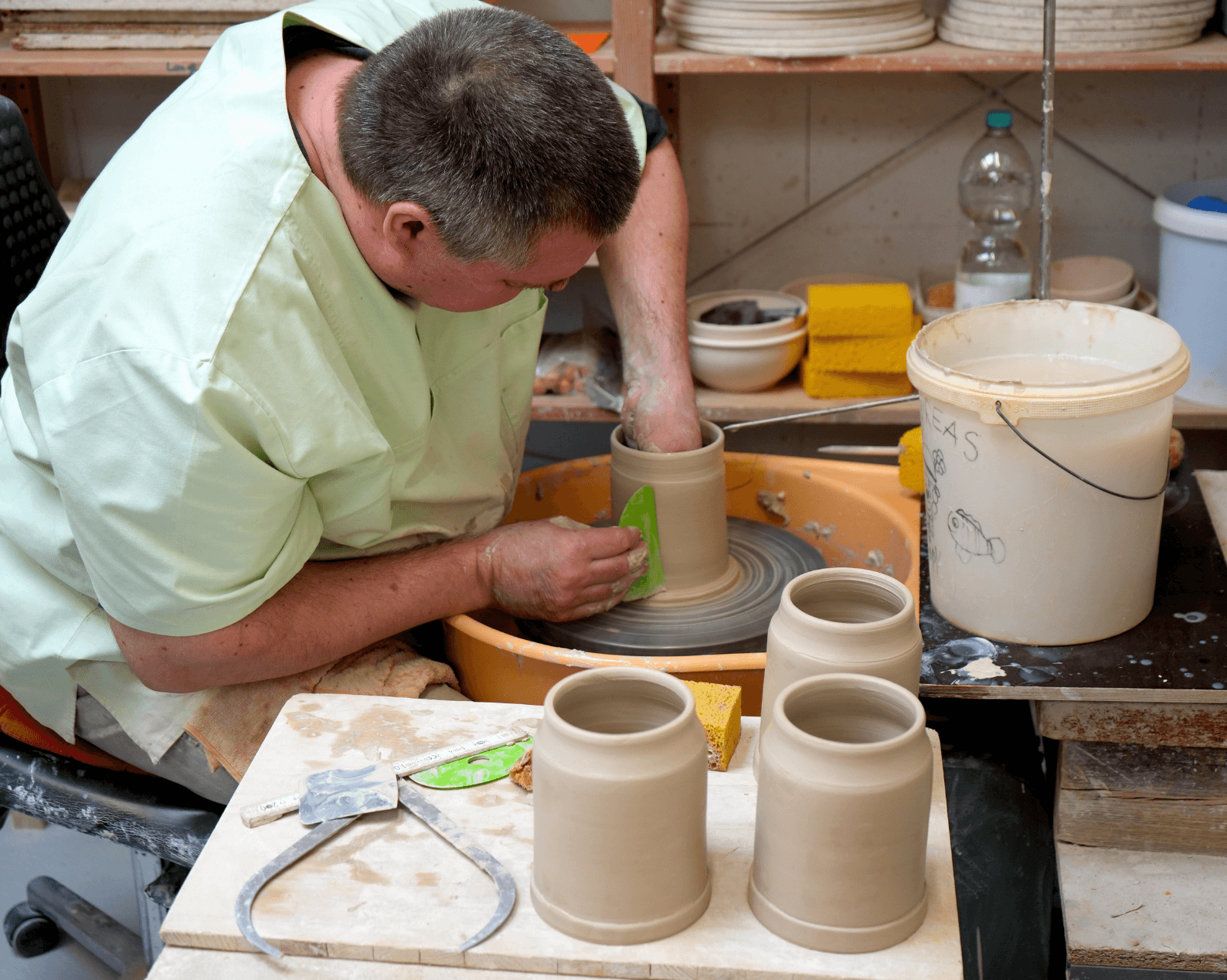
A man with short dark hair wearing a green T-shirt is working at a potter’s wheel, shaping a cylindrical vessel out of clay. On the table are tools, a sponge, scraps of clay, and already-thrown blanks. Behind him are shelves holding bowls and other ceramic pieces.
With technical precision and pedagogical sensitivity, Andreas Heubaum plays a key role in the success of the ceramics series.

“The main thing is that people are happy” 

Joshua Long, who has worked in the pottery studio for seven years, lights up the entire room with his enthusiasm. “I’m happy when people see what we do here,” he says. “The main thing is that people are satisfied and have a smile on their faces.” 

Joshua shapes plates, coasters, and bowls. He is also a shop steward and advocates for equality and a positive work environment. His pride is palpable, his joy contagious. “We’re glad we can work and that people use our things. That makes me happy.”

A gift that lasts 

What is created in the pottery studio is more than just ceramics. It is a piece of Nuremberg – handmade, local, and durable. A product that brings people together: those who make it and those who will use it. 

For us, this collaboration is an opportunity to learn from one another: projects like the regional ceramics highlight our strengths and demonstrate the opportunities that arise when people with different skills come together – from Monika Geldhauser’s design vision and Andreas Heubaum’s mastery to Joshua Long’s enthusiasm and social awareness.  

Between clay and focused gazes, something unique emerges: craftsmanship born of a local community that travels the world as an ambassador for Nuremberg.

A man with short black hair, wearing a cap and a black-and-white scarf, along with a black sweater and jeans, is pouring liquid clay from a large measuring cup into a two-part plaster mold. In the background, shelves are filled with additional molds, tools, and materials.
Joshua Lang is deeply committed to the ceramics production process and demonstrates the care that goes into every single step.

The people behind the ceramic craft

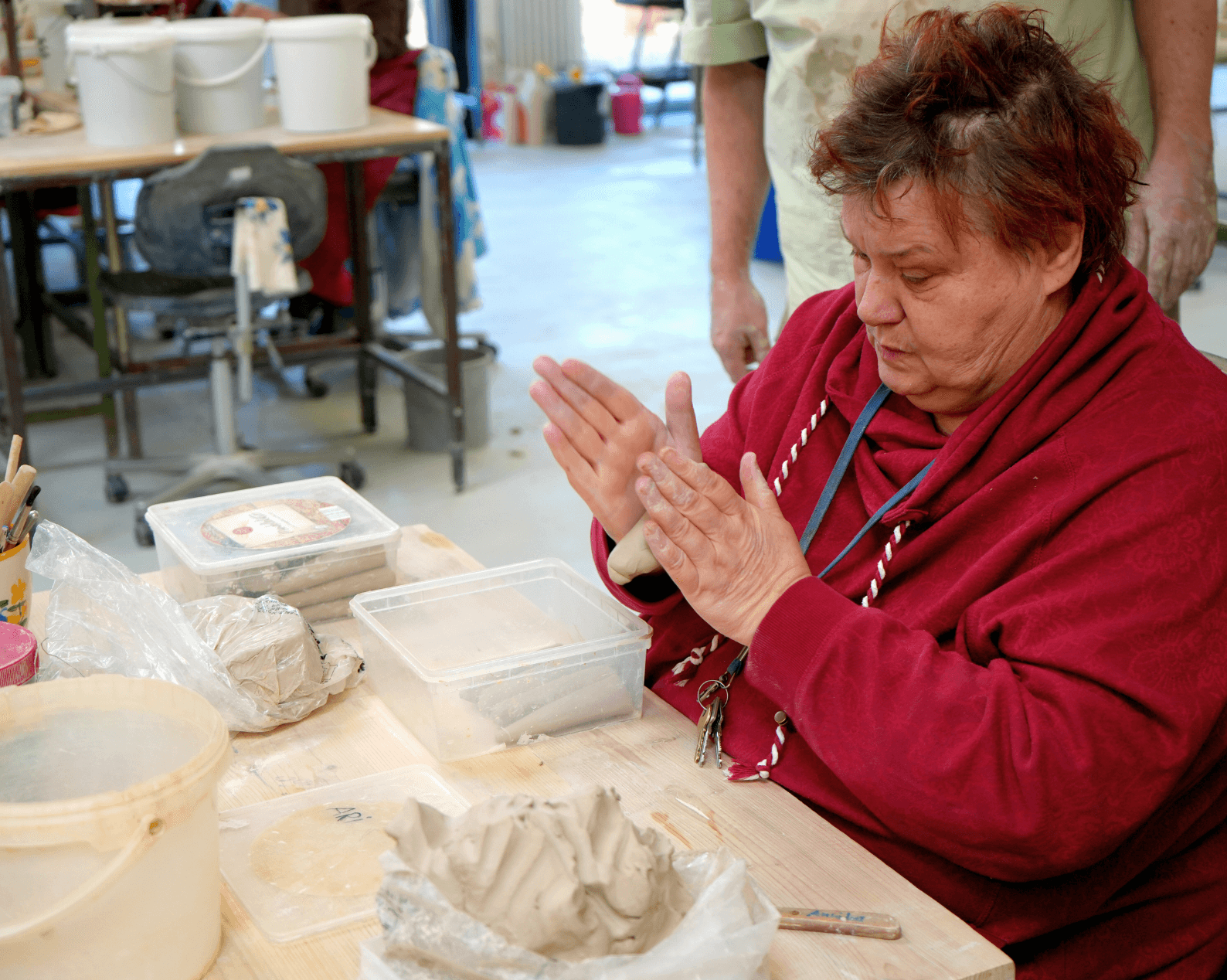
A woman with short black hair and orange highlights, wearing a red sweater, is sitting at a workbench, shaping clay with her hands. On the table are lumps of clay, toolboxes, plastic containers, and other materials used in pottery-making. In the background, workbenches and other workshop equipment are visible.
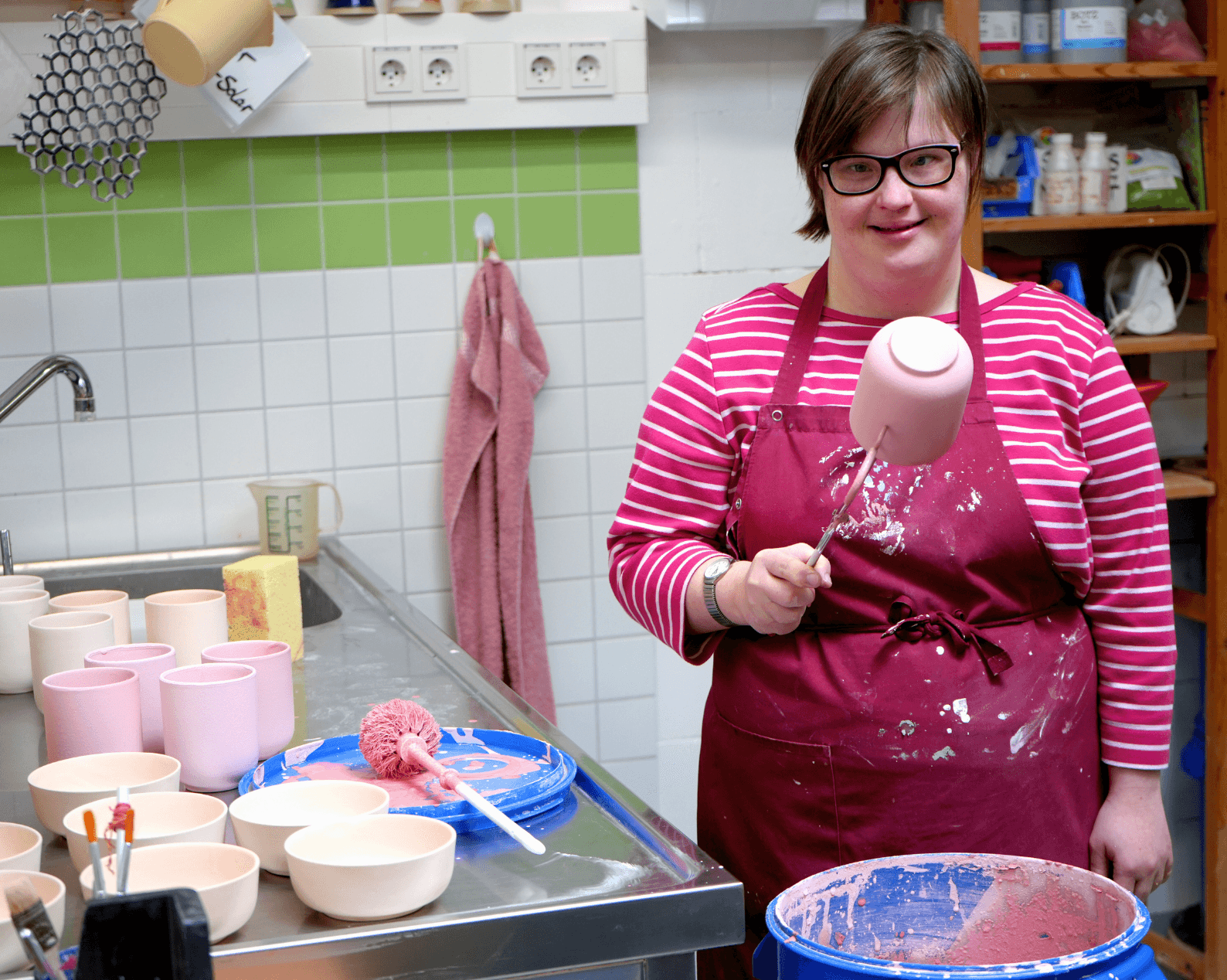
A woman with short light brown hair and glasses, wearing a pink-and-white striped sweater and a dark red apron, is holding a pink glazed ceramic mug over a large blue bucket with a pair of tongs, surrounded by finished glazed mugs, bowls, tools, glaze containers, and a stainless steel work surface. In the background are shelves holding additional materials.
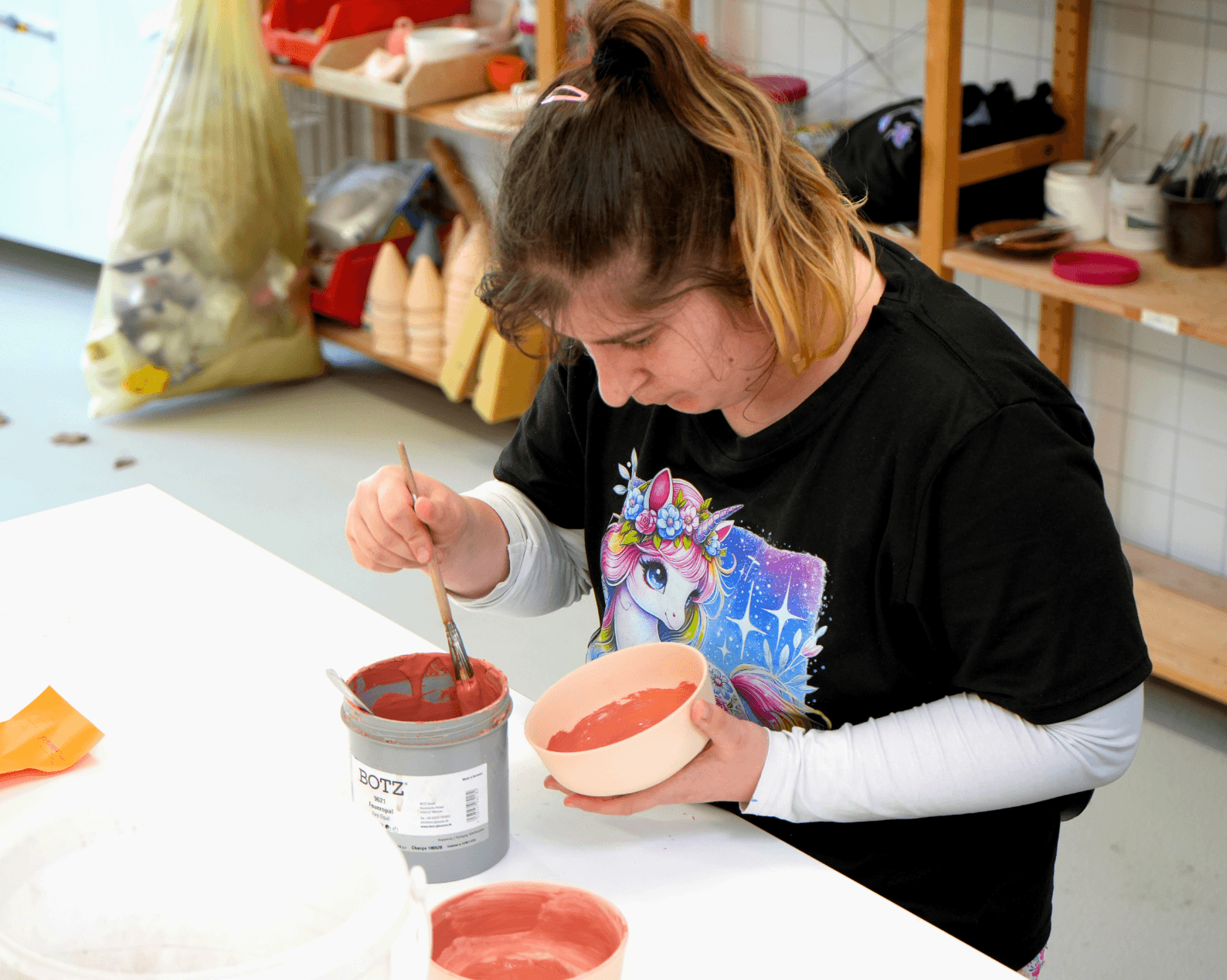
A woman with dark hair and a long blonde braid, wearing a white sweater and a black T-shirt printed with a unicorn, is sitting at a table and applying red glaze to a ceramic bowl with a brush. In front of her are glaze containers, tools, and other materials. In the background are shelves with supplies and packaging materials.
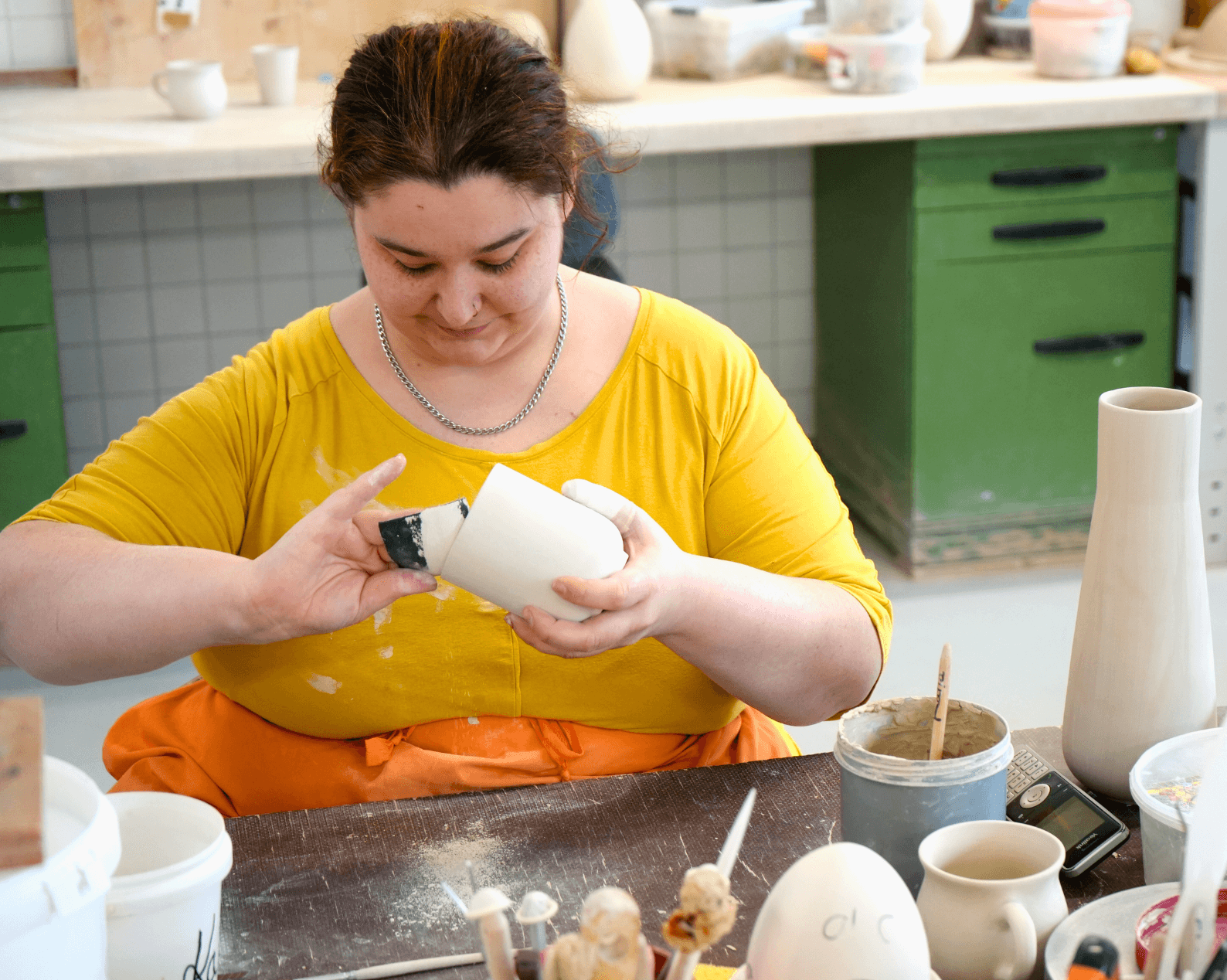
A woman with long brown hair, wearing a yellow T-shirt and an orange apron, is sitting at a workbench in a pottery studio, shaping a light-colored ceramic vessel with a tool. Various supplies are scattered across the table, including brushes, leftover clay, glaze containers, water jugs, and a cell phone. In the background is a work surface with additional unglazed ceramic pieces and tools.
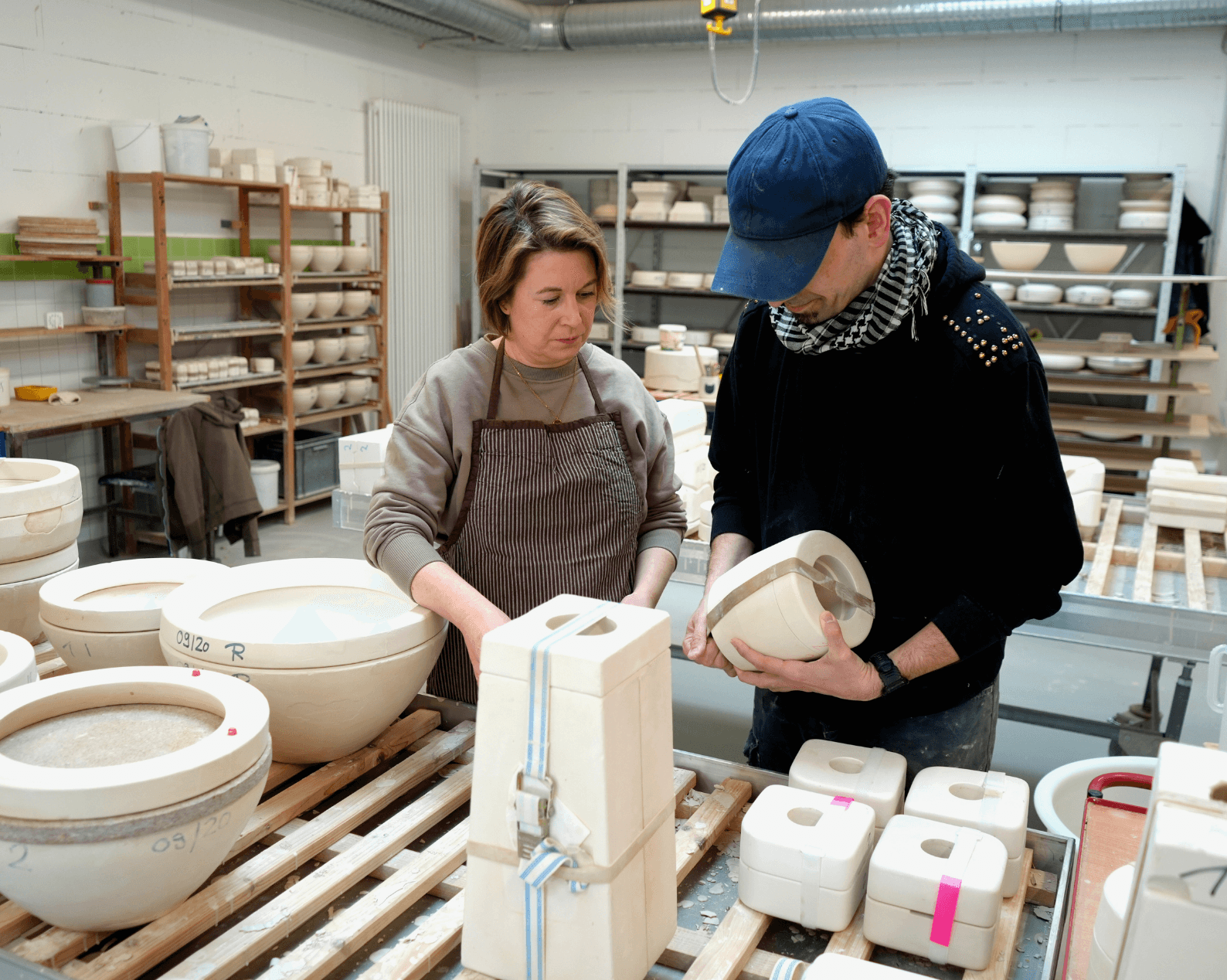
A woman and a man are standing in a ceramics workshop at a large workbench covered with numerous plaster molds, half-finished bowls, and other ceramic pieces. The woman with short blonde hair is wearing a brown sweater and a brown apron and is standing in front of several large round molds, while the man with short black hair, a cap, and a black-and-white scarf, dressed in a black sweater and jeans, is holding a plaster mold in his hands. In the background are shelves filled with additional ceramic molds and vessels, as well as workshop equipment.
A man with short dark hair wearing a green T-shirt is working at a potter's wheel, shaping a cylindrical vessel out of clay. One of his arms guides a tool against the rotating form, while several other turned blanks, a bucket of water, and various tools lie on the workbench in front of him. In the background, shelves with additional ceramic pieces and a water bottle can be seen.
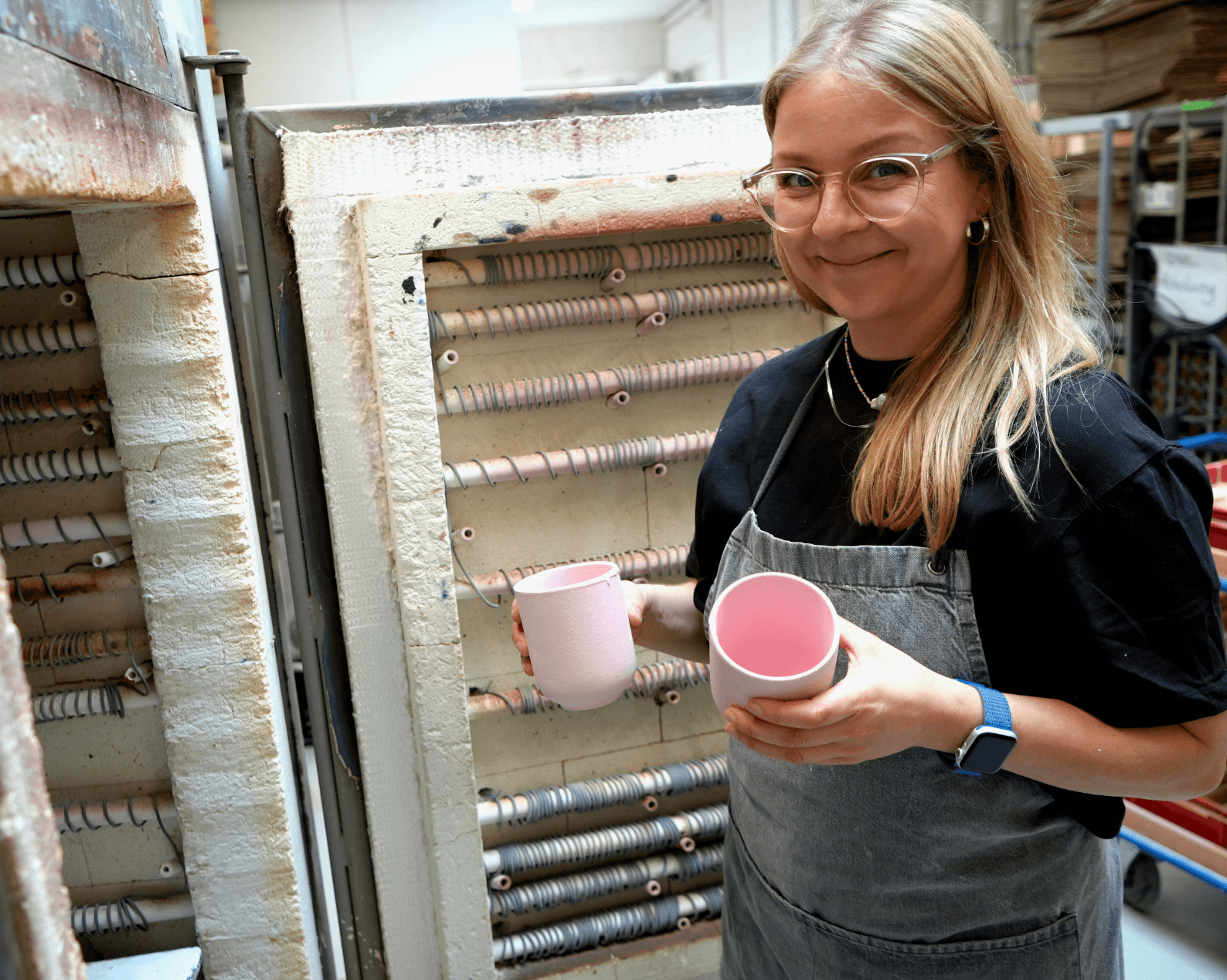
A woman with long blonde hair and glasses, wearing a black T-shirt and a gray apron, stands in front of an open kiln, holding two pink ceramic mugs in her hands. The kiln reveals internal heating coils and shelves for ceramics. The woman is wearing an apron, and other workshop equipment can be seen in the background.
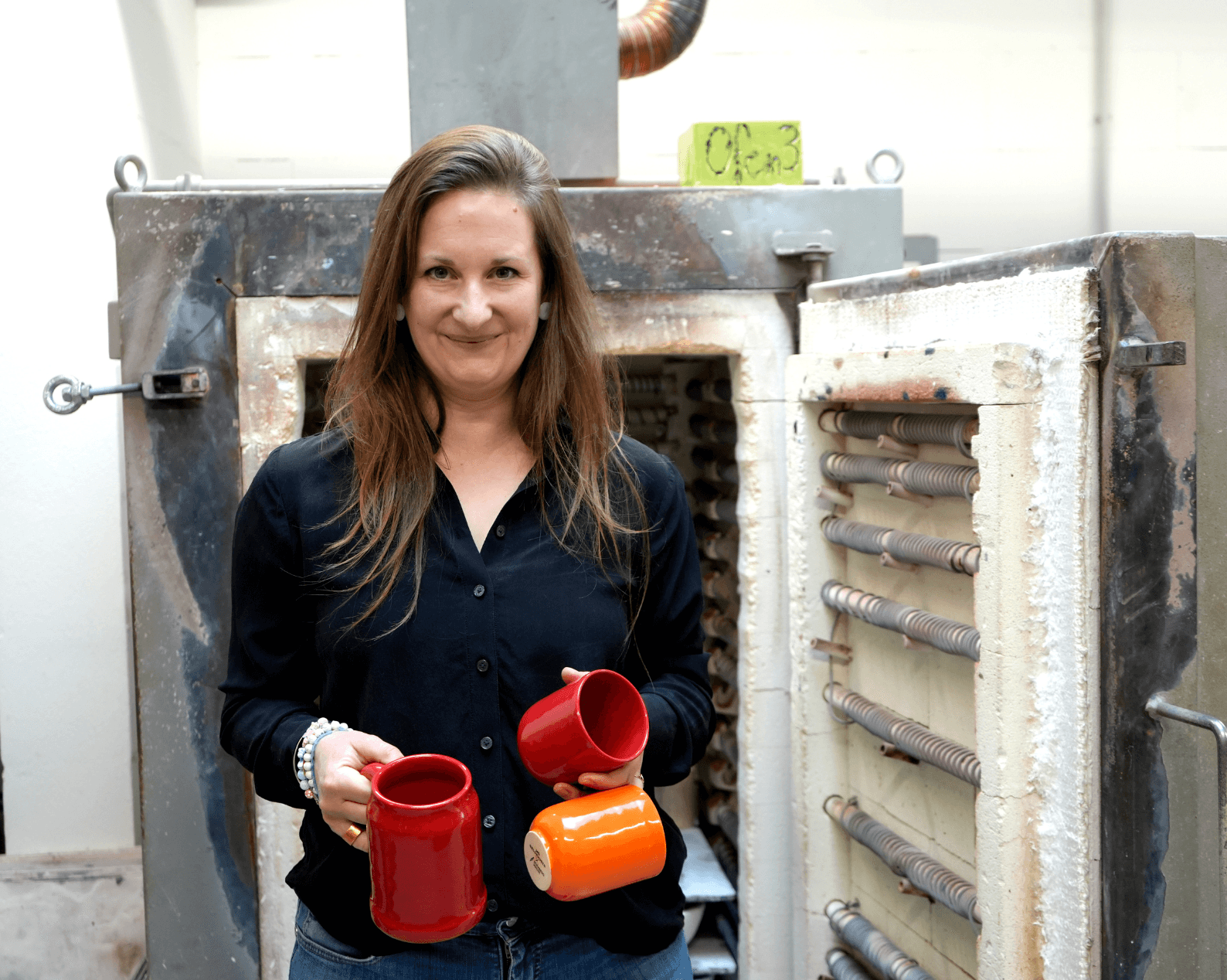
A woman with long brown hair, wearing a black blouse and jeans, stands in front of an open kiln, holding two glazed ceramic cups – one red and one orange – and a finished red jug. The open kiln reveals heating coils and shelves inside.
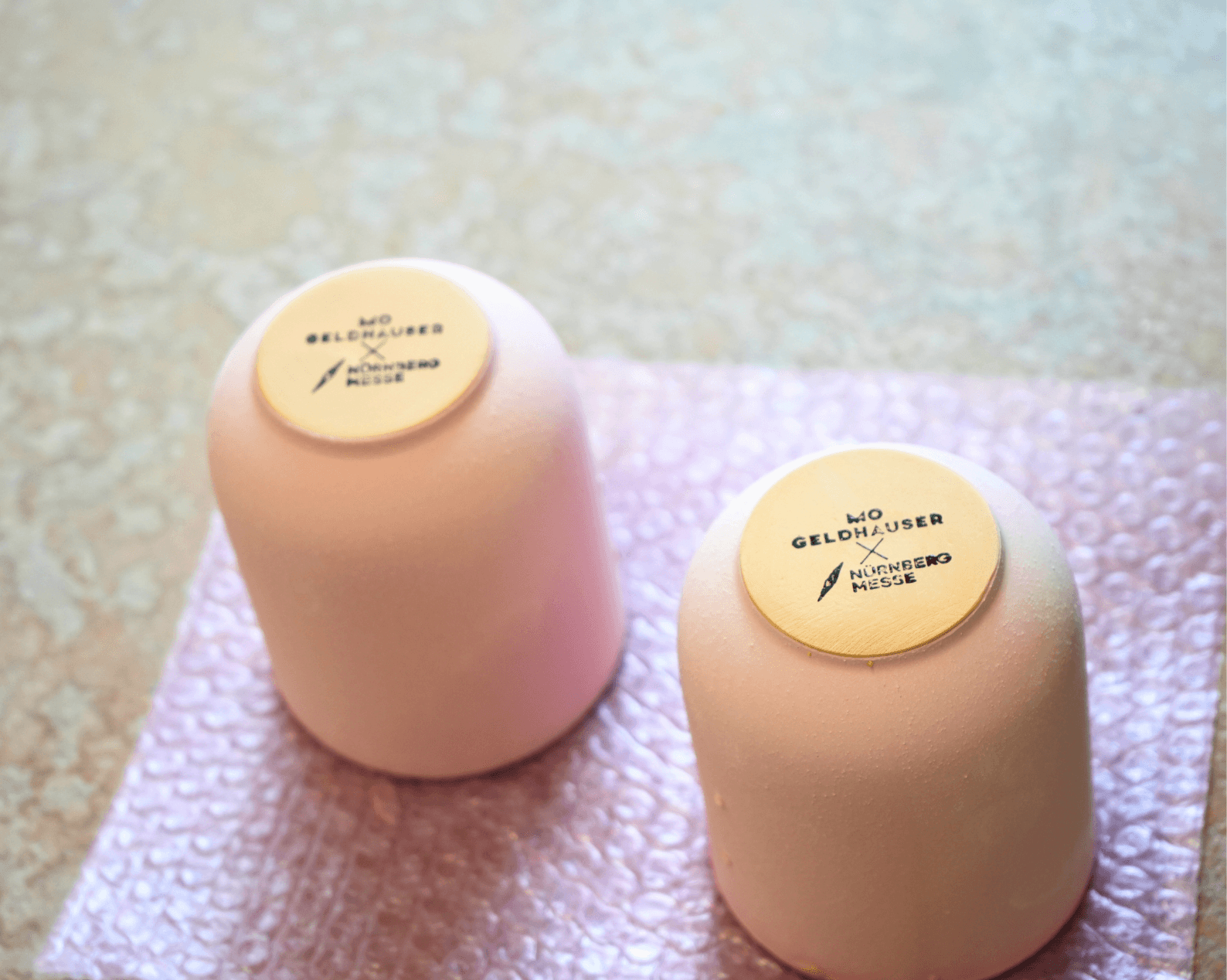
Two upside down pink ceramic cups rest on a padded surface. Circular labels on the bases read “Geldhauser × NürnbergMesse.”
19

Author

Portrait Johanna Köhler
Johanna Köhler
Online Editing // PR Trainee